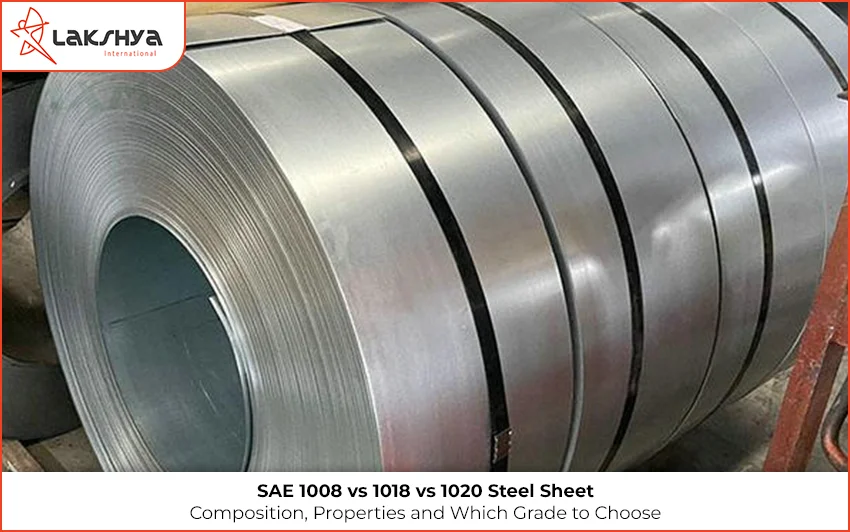
SAE relates to the makeup or alloying of steel, whereas sheet standards such as ASTM A1008 or ASTM A1011 go directly to form, properties, and requirements of the material.It is important to note the difference when writing an RFQ or having the mill test certificate checked.
Composition at a Glance: Carbon and Manganese Ranges Compared
The easiest way to understand the difference between 1008 vs 1018 vs 1020 steel is to compare their carbon and manganese ranges. SAE 1008 has the lowest carbon content, while SAE 1018 has substantially more manganese. SAE 1020 has a higher carbon range than 1018 but a lower manganese range.
| Element | SAE 1008 | SAE 1018 | SAE 1020 |
| Carbon, C | 0.10% max | 0.15 to 0.20% | 0.18 to 0.23% |
| Manganese, Mn | 0.30 to 0.50% | 0.60 to 0.90% | 0.30 to 0.60% |
| Phosphorus, P | 0.030% max | 0.030% max | 0.030% max |
| Sulfur, S | 0.050% max | 0.050% max | 0.050% max |
| Iron, Fe | Balance | Balance | Balance |
| UNS number | G10080 | G10180 | G10200 |
| Carbon classification | Very low | Low | Low |
SAE 1018 has the highest manganese range of the three, contributing to its strength and useful machining characteristics. SAE 1018 has the highest manganese range of the three, contributing to its strength and useful machining characteristics. SAE 1020 has more carbon than 1018 but less manganese.
What Each Grade Is: 1008, 1018 and 1020 in Sheet Form
SAE 1008 Steel Sheet
SAE 1008 is a very low carbon grade with carbon up to 0.10% and manganese generally between 0.30 and 0.50%. Its low carbon content provides good ductility and forming performance. 1008 steel sheet composition makes it suitable for bending, drawing and cold-rolled sheet applications such as appliance panels, automotive components, enclosures, and formed parts.
For buyers comparing the difference between 1008, 1018 and 1020 steel, 1008 generally offers the strongest focus on formability among these grades.
SAE 1018 Steel Sheet
SAE 1018 contains 0.15 to 0.20% carbon and 0.60 to 0.90% manganese. Compared with 1008, its higher manganese content contributes to greater strength while maintaining good workability and weldability. 1018 steel sheet is used for general engineering components, machined parts, pins, fixtures, and shafts. It can also receive carburizing or case hardening.
Lakshya provides detailed information on SAE 1018 steel, including its composition, properties, standards, and applications.
SAE 1020 Steel Sheet
SAE 1020 steel contains 0.18 to 0.23% carbon and 0.30 to 0.60% manganese. In the 1018 vs 1020 steel sheet comparison, 1020 has a higher carbon range but lower manganese. It provides a useful balance of strength and formability for brackets, welded structures, and mechanical components.
When comparing 1008 vs 1018 steel or 1008 vs 1020 steel, buyers should consider the actual product specification, thickness, delivery condition, and certificate. ASTM A1008 vs SAE 1008 should also be distinguished because they represent different types of designations.
Grade vs Sheet Specification: SAE 1008 Is Not the Same as ASTM A1008
One of the most important points when ordering steel sheet is understanding the difference between a grade and a product specification.
SAE 1008 identifies a carbon steel chemistry. The number tells you the grade and its chemical composition range. ASTM A1008, in contrast, is a specification covering cold rolled steel sheet and includes requirements relating to product type, quality designation, mechanical properties, testing and other requirements.
The same principle applies to other sheet specifications. ASTM A1011 covers hot rolled sheet products, while ASTM A1018 covers hot rolled heavy thickness coils beyond the size limits covered by ASTM A1011.
| Standard | What it covers | Relevance to this comparison |
| ASTM A1008 | Cold rolled carbon and related steel sheet in coils and cut lengths | Important when ordering cold rolled sheet |
| ASTM A1011 | Hot rolled carbon and related steel sheet and strip | Relevant to hot rolled sheet requirements |
| ASTM A1018 | Hot rolled heavy thickness sheet and strip coils | Relevant where heavy thickness falls within its scope |
| IS 513 | Cold reduced carbon steel sheet and strip for cold forming and drawing purposes | Indian cold reduced sheet specification |
| IS 1079 | Hot rolled carbon steel sheet, plate and strip | Indian hot rolled product specification |
Therefore, saying “ASTM A1008 steel” does not automatically mean that the material is simply “SAE 1008”. The chemistry, quality designation and product requirements all need to be considered.
Always check the current ASTM scope for the exact product you are ordering.
Mechanical Properties Compared: Hot Rolled and Cold Worked
Mechanical properties depend strongly on product form and processing condition. A value for a cold worked product should not be placed beside a hot rolled value and treated as a direct grade comparison.
The figures below are typical values, not specification minimums. They should not replace the mechanical requirements of the governing sheet specification or the values shown on the mill test certificate.
Typical Cold Worked Values
| Property | SAE 1008 | SAE 1018 | SAE 1020 |
| Tensile strength | About 340 MPa | About 440 MPa | About 420 MPa |
| Yield strength | About 285 MPa | About 370 MPa | About 350 MPa |
| Elongation | About 20% | About 15% | About 15% |
| Brinell hardness | About 95 HB | About 126 HB | About 121 HB |
Typical Hot Rolled Values
| Property | SAE 1008 | SAE 1018 | SAE 1020 |
| Tensile strength | About 303 MPa | About 400 MPa | About 380 MPa |
| Yield strength | About 170 MPa | About 220 MPa | About 210 MPa |
| Elongation | About 30% | About 25% | About 25% |
| Brinell hardness | About 86 HB | About 116 HB | About 111 HB |
These values illustrate why condition matters. Cold working can raise strength and hardness while reducing elongation. Hot rolled material generally has lower strength and greater elongation than the corresponding cold worked condition.
SAE 1018 and SAE 1020 can overlap significantly in strength. The higher manganese level in 1018 helps distinguish its chemistry, but the actual mechanical result also depends on processing, thickness and delivery condition.
For general physical properties, all three grades have similar density and elastic modulus. Mild steel density is approximately 7.85 g/cm³ and the elastic modulus is around 200 GPa.
Which Steel Sheet Grade Should You Choose?
The correct grade depends on what the component has to do rather than the grade number alone.
| Application | Grade to consider | Main reason |
| Appliance and enclosure panels | SAE 1008 | High formability and suitable sheet surface |
| Automotive stampings and deep drawn parts | SAE 1008 | Lower carbon and good drawing behaviour |
| Welded frames and brackets | SAE 1020 or SAE 1018 | General fabrication and moderate strength |
| Machined plates and fixtures | SAE 1018 | Useful machining characteristics |
| General fabrication | SAE 1020 or SAE 1018 | Balanced low carbon steel properties |
Equivalent Grades for 1008, 1018 and 1020
International grade comparisons can be useful for export purchasing, but equivalent does not mean identical. Chemistry, product form, heat treatment, mechanical requirements and testing requirements can differ between standards.
| SAE or AISI grade | Commonly referenced EN or European grade | DIN reference | JIS reference | GB reference |
| SAE 1008 | DC01 or a close low carbon reference depending on product form | St12 or related historical reference | SPCC | 08 |
| SAE 1018 | C15E or C16E as close chemistry references | C15 or C15E | S15C | 15 |
| SAE 1020 | C22 | C22 | S20C | 20 |
These are closest references rather than automatic substitutions. In particular, DC01 is a cold rolled sheet designation, while C15E and C22 are chemistry based engineering grades. A buyer should therefore compare the complete governing specification rather than replacing one designation with another only because a cross reference table shows them together.
For export orders, the purchase document should identify the required standard, grade, product form, condition, and testing requirements.
FAQs about 304 Stainless Steel Tubes
What is the difference between SAE 1008, 1018 and 1020 steel sheet?
The difference is mainly chemical composition. SAE 1008 has the least carbon, 1018 has the most manganese and 1020 has slightly more carbon than 1018, which affects strength, forming and machining.
Which of the three has the highest carbon content?
SAE 1020 has the highest carbon range at 0.18 to 0.23%, followed by 1018 at 0.15 to 0.20% and 1008 at up to 0.10%.
Is 1018 stronger than 1020?
The strength of 1018 and 1020 sheet can overlap. Strength depends on chemistry, thickness and delivery condition, so grade alone does not decide it.
Which grade is best for deep drawing and bending?
SAE 1008 is generally preferred for demanding forming, bending and drawing because it has the lowest carbon content of the three low carbon steel sheet grades.
Which grade is best for welding?
All three are generally weldable. SAE 1008 has the lowest carbon content, while welding 1018 or 1020 requires consideration of thickness, heat input and joint design.
Is ASTM A1008 the same as SAE 1008?
No. ASTM A1008 and SAE 1008 are different kinds of designation. SAE 1008 identifies chemistry, while ASTM A1008 specifies requirements for cold rolled steel sheet.
Can I substitute 1020 for 1018 in a sheet order?
Substitution depends on application requirements. Compare chemistry, mechanical properties and specifications before replacing 1018 steel sheet with 1020 steel sheet, and obtain engineering approval when required.
Can 1008, 1018 or 1020 be hardened?
These grades are not normally selected for through hardening. SAE 1018 can undergo carburizing or case hardening, producing a harder surface with a lower carbon core.
What is the difference between 1008 steel sheet and 1018 steel?
SAE 1008 has lower carbon than 1018 (0.10% max against 0.15 to 0.20%), which generally makes it better for forming, while 1018 offers higher strength and a better case hardening response.
What is the difference between 1008 and 1020 steel?
The main difference between 1008 and 1020 is carbon: 1020 has 0.18 to 0.23% against 0.10% max, which generally gives more strength and less forming capability.
What is the difference between cold rolled and hot rolled 1018?
Cold rolled 1018 generally has a smoother surface, tighter thickness control and higher strength, while hot rolled 1018 has a rougher scaled surface and higher elongation. The suitable form depends on the governing sheet specification.
Conclusion
SAE 1008, 1018 and 1020 are all low carbon steel grades, but their different carbon and manganese ranges give them different practical characteristics. SAE 1008 is generally associated with forming and drawing, SAE 1018 offers useful machining and case hardening characteristics, and SAE 1020 is widely used for general fabrication and mechanical applications.
If you need help specifying the required grade, thickness or sheet standard, send your requirement to Lakshya International for a quotation.