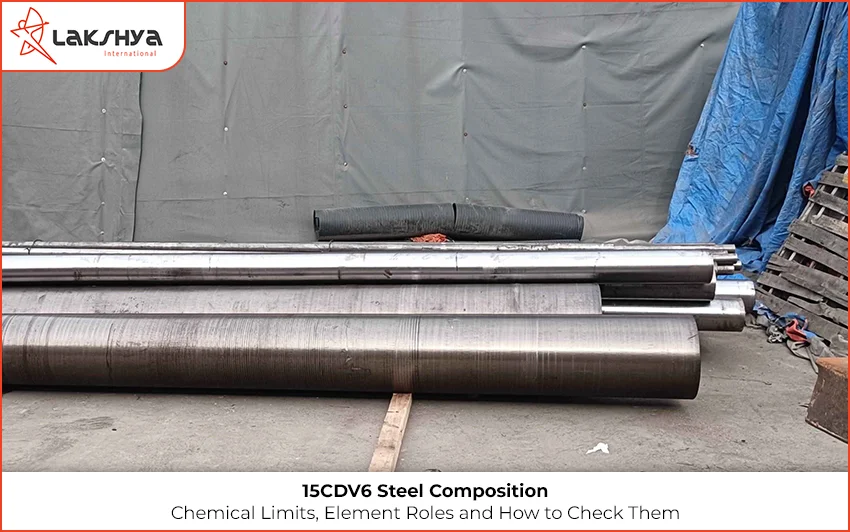
Search for the 15CDV6 steel composition and you will find more than one version of the numbers, which is a real problem when you are checking a certificate. The aerospace limits for 15CDV6 chemical composition are carbon 0.12 to 0.18%, manganese 0.80 to 1.10%, silicon 0.20% max, phosphorus 0.020% max, sulfur 0.015% max, chromium 1.25 to 1.50%, molybdenum 0.80 to 1.00% and vanadium 0.20 to 0.30%, with iron making up the rest.
Those figures apply to W.Nr 1.7734, the same steel sold as 15CrMoV6 and specified to AIR 9160C, and they are the ones repeated on the aerospace datasheets we checked. This guide sets out the full table, what each element does, why other tables do not match, and how to check a mill certificate.
Lakshya International has been in the steel business since 1987 and works to ISO 9001:2015 (see our About Us and certificate pages). The checks below are the ones a buyer can run on any 15CDV6 certificate.
15CDV6 Chemical Composition: The Full Limits Table
This is the 1.7734 chemical composition, also written as the 15CrMoV6 composition, as listed on aerospace datasheets for AIR 9160C. Every heat should sit inside these limits, and any 15CDV6 datasheet you are given should show the same figures.
|
Element |
Symbol |
Requirement (heat analysis, %) |
Role in the steel |
|
Carbon |
C |
0.12 to 0.18 |
Kept low so the steel stays weldable and tough |
|
Silicon |
Si |
0.20 max |
Deoxidiser, held low |
|
Manganese |
Mn |
0.80 to 1.10 |
Adds hardenability and strength |
|
Phosphorus |
P |
0.020 max |
Impurity, held very low for toughness |
|
Sulfur |
S |
0.015 max |
Impurity, held very low for clean steel |
|
Chromium |
Cr |
1.25 to 1.50 |
Hardenability and resistance to softening |
|
Molybdenum |
Mo |
0.80 to 1.00 |
Strength, resists temper embrittlement |
|
Vanadium |
V |
0.20 to 0.30 |
Fine grain and toughness |
|
Iron |
Fe |
Balance |
The rest of the analysis |
Two things stand out. Phosphorus and sulfur are far tighter than in a general purpose alloy steel, and chromium, molybdenum and vanadium together do the heavy lifting on strength while carbon stays low.
What Each Element Does in 15CDV6 Steel
The table tells you what is allowed, not why. For the wider picture on how carbon shapes steel, see our guide tocarbon steel properties. Molybdenum here is an alloying element. If you are looking for the pure metal, read our guide tomolybdenum rods, pipes, sheets and moly cups.
Carbon: Why the Range Is So Low
At 0.12 to 0.18% carbon, 15CDV6 gives up the easy strength that carbon provides and takes it from alloying instead. The payoff is toughness and weldability, which is the reason aerospace and motorsport designers pick it over higher carbon Cr Mo steels.
Manganese: Hardenability and Strength
Manganese at 0.80 to 1.10% is higher than in a plain 4130 type steel. It helps the steel harden through the section and ties up sulfur so that hot working does not cause cracking.
Phosphorus and Sulfur: Very Tight Impurity Limits
Phosphorus at 0.020% and sulfur at 0.015% maximum are impurity limits set for toughness and clean steel. They are tighter than the 0.035% and 0.040% that a general grade such as 4130 allows.
Silicon: A Low Ceiling
Silicon acts as a deoxidiser and is capped at 0.20%. Note that many general alloy steels allow up to 0.35%, so a table showing 0.15 to 0.35% silicon for 15CDV6 is describing another steel.
Chromium: Hardenability and Temper Resistance
Chromium at 1.25 to 1.50% raises hardenability and helps the steel keep its strength when tempered. It is a strength element in this steel, not a corrosion resistance element, because 15CDV6 is not a stainless steel.
Molybdenum: Strength and Temper Embrittlement Resistance
Molybdenum at 0.80 to 1.00% is roughly four times the level in 4130. It adds strength at room and raised temperature and reduces the risk of temper embrittlement.
Vanadium: Grain Refinement
Vanadium at 0.20 to 0.30% forms fine carbides that hold the grain size down. Finer grain means better toughness and fatigue behaviour at the same strength.
Why 15CDV6 Composition Tables Differ Online, and How to Spot a Wrong One
Search results show at least three different sets of limits for the same grade. There are three usual causes: a table copied from a similar steel, a commercial variant with wider limits presented as the specification, and plain typing slips. The comparison below shows the values that most often go wrong.
|
Element |
Aerospace limit (%) |
A wrong value seen online (%) |
What it resembles |
|
Chromium |
1.25 to 1.50 |
0.80 to 1.10 |
The chromium range of AISI 4130 |
|
Molybdenum |
0.80 to 1.00 |
0.15 to 0.25, or 0.70 to 0.90 |
The first is the 4130 molybdenum range, the second matches no standard limit found |
|
Manganese |
0.80 to 1.10 |
0.40 to 0.70, or 0.50 to 0.80 |
Closer to 4130 (0.40 to 0.60) |
|
Phosphorus, sulfur |
0.020 and 0.015 max |
0.035 or 0.025 max |
General purpose alloy steel limits |
|
Silicon |
0.20 max |
0.15 to 0.35 |
The silicon range of AISI 4130 |
Use the Name as a Check
The designation itself tells you about the chemistry. In 15CDV6, the 15 is about 0.15% carbon, C stands for chromium, D for molybdenum and V for vanadium. The 6 gives chromium as 6 divided by 4, which is about 1.5%. A table showing 0.80 to 1.10% chromium describes a 4130 type steel (the French name for that steel is 25CD4), not 15CDV6.
Wider limits are sometimes quoted for non aerospace supply. Whatever the website says, the specification and the mill test certificate govern.
How to Read the Chemistry on a 15CDV6 Mill Test Certificate
The chemistry on a 15CDV6 certificate is a heat analysis, the result for the melt the material came from. The certificate should also name the specification, the delivery condition and the heat number, and the same heat number should be marked on the material so you can tie the two together.
Your specification sets any allowed variation between heat analysis and product analysis on the finished item, so check that clause if you plan to test material on receipt.
|
Certificate field |
Example entry |
What to check |
|
Designation and specification |
15CDV6, W.Nr 1.7734 (AIR 9160C) |
Matches the purchase order |
|
Condition |
1.7734.5 |
Same condition as ordered |
|
Heat number |
H12345 (example) |
Same number marked on the material |
|
Melt route |
ESR |
As ordered (air, ESR or VAR) |
|
Carbon (%) |
0.15 |
0.12 to 0.18 |
|
Silicon (%) |
0.12 |
0.20 max |
|
Manganese (%) |
0.95 |
0.80 to 1.10 |
|
Phosphorus (%) |
0.010 |
0.020 max |
|
Sulfur (%) |
0.004 |
0.015 max |
|
Chromium (%) |
1.38 |
1.25 to 1.50 |
|
Molybdenum (%) |
0.90 |
0.80 to 1.00 |
|
Vanadium (%) |
0.24 |
0.20 to 0.30 |
|
IIW carbon equivalent |
0.81 |
Only if the order sets a limit |
|
0.2% proof, tensile, elongation |
820 MPa, 1040 MPa, 14% |
980 to 1180 MPa tensile and 790 MPa proof minimum for the .5 condition |
|
Hardness |
310 HB |
293 to 352 for the .5 condition |
|
Certificate type |
EN 10204 3.1 |
3.2 if a third party witnessed the tests |
A six step check
- Match the heat number on the certificate to the marking on the material.
- Confirm the designation, specification and delivery condition.
- Compare every element with the composition table, paying attention to the tight phosphorus and sulfur limits.
- Confirm the melt route if the order specified one.
- Check that the mechanical results sit inside the range for the stated condition.
- Confirm the certificate type and any traceability requirement on the order.
Melt route matters for cleanliness. Our ESR alloy steel page explains the remelting route and lists 15CDV6 among the grades. Reading a certificate and something does not add up? Send the chemistry block to our team through Enquire Now and we will check it against these limits.
Designations and Equivalents for 15CDV6
Buyers search by whichever name their drawing uses, so these are the names that refer to the 15CDV6 material. There is no exact AISI or SAE 15CDV6 equivalent, and 4130 is a comparison, not an equivalent.
|
Designation |
System |
Note |
|
15CDV6 |
French name |
Carbon 0.15, chromium, molybdenum, vanadium, chromium about 1.5 |
|
15CrMoV6 |
German style short name |
The same steel |
|
W.Nr 1.7734 |
German material number |
Aerospace sheet WL 1.7734 |
|
AIR 9160C |
French aerospace standard |
Listed by stockists for this grade |
|
LN 668, MN 1013 |
Round bar |
As listed by stockists |
|
ASNA 3108, DIN 65389, DIN 65390 |
Sheet and plate |
As listed by stockists |
|
LN 9369, TE014 |
Seamless tube |
As listed by stockists |
|
DIN 65035 |
Forging billet |
As listed by stockists |
Specification numbers by product form are as listed by stockists. Confirm each against the standard named on your order.
Where 15CDV6 Is Used
|
Application |
Why 15CDV6 suits it |
|
Roll cages and vehicle frames |
High strength for weight, and it welds |
|
Suspension wishbones and uprights |
High yield strength with toughness |
|
Track rods and push rods |
Strength and fatigue behaviour in slender parts |
|
Pressure vessels |
Strength with weldability |
|
Rocket motor casings |
High strength in thin walled, welded structures |
Applications as listed on stockist datasheets and product pages.
How to Specify 15CDV6 When You Order
A clear order avoids most certificate disputes. Include these items on your enquiry:
- Designation and specification: 15CDV6, W.Nr 1.7734, AIR 9160C or your customer specification.
- Condition: annealed (.2) or a numbered strength condition (.4, .5, .6).
- Form and size: bar, sheet, plate, tube or forging billet, with dimensions and tolerances.
- Melt route: air, ESR or VAR.
- Chemistry and tests: the composition limits, mechanical tests and any nondestructive testing.
- Certificate and inspection: EN 10204 3.1 or 3.2, third party inspection if needed, and traceability requirements.
Ready to ask? Send your specification and condition through Enquire Now.
FAQs about 304 Stainless Steel Tubes
What is the chemical composition of 15CDV6 steel?
Carbon 0.12 to 0.18%, silicon 0.20% max, manganese 0.80 to 1.10%, phosphorus 0.020% max, sulfur 0.015% max, chromium 1.25 to 1.50%, molybdenum 0.80 to 1.00% and vanadium 0.20 to 0.30%, with iron as the balance. The table above shows the role of each element.
What is the carbon content of 15CDV6?
Carbon is 0.12 to 0.18%. It is deliberately low so the steel stays tough and weldable. Strength comes mainly from chromium, molybdenum and vanadium, which is why the steel reaches high strength after heat treatment.
Why do some websites show a different 15CDV6 composition?
Tables are often copied from a similar steel such as 4130, mix in wider commercial limits, or contain typing slips. Use the aerospace specification and your mill test certificate. The section on wrong tables above shows the values that most often go astray.
Is 15CDV6 the same as 1.7734 and 15CrMoV6?
Yes. They are the same steel under French, German material number and German style names. AIR 9160C is the French aerospace standard listed for it. The delivery condition is added as a suffix, for example 1.7734.5.
Is 15CDV6 stainless steel?
No. It is a low alloy steel with about 1.4% chromium. That is enough for hardenability and temper resistance but far below the 10.5% or more needed for stainless behaviour, so it needs protection from corrosion.
How does 15CDV6 compare with 4130?
15CDV6 has about half the carbon (0.12 to 0.18% against 0.28 to 0.33%) and much more chromium, molybdenum and vanadium. Suppliers report higher yield strength than 4130 with good weldability. It is a different steel, not an equivalent.
Is 15CDV6 weldable?
Yes, with a qualified procedure. Low carbon helps, but chromium, molybdenum and vanadium push the carbon equivalent to roughly 0.70 to 0.92 across the limits. Follow your fabrication specification for preheat and heat treatment.
What do 1.7734.4, .5 and .6 mean?
They are delivery conditions of the same composition. Datasheets show tensile strength of about 700 MPa minimum for .4, 980 to 1180 MPa for .5 and 1080 to 1250 MPa for .6. The .2 condition is annealed.
Checking 15CDV6 Composition: The Short Rule
Check the specification and condition first, then every element against the table, and pay closest attention to phosphorus, sulfur, chromium and molybdenum, because those are the values that wrong tables get wrong. Ask for a carbon equivalent if the part will be welded. When a website and a certificate disagree, the certificate wins.
Related reading: our 15CDV6 alloy steel page covers forms and sizes, and more technical guides are on our blog. If a certificate raises a question, send it to our team through the enquiry page.