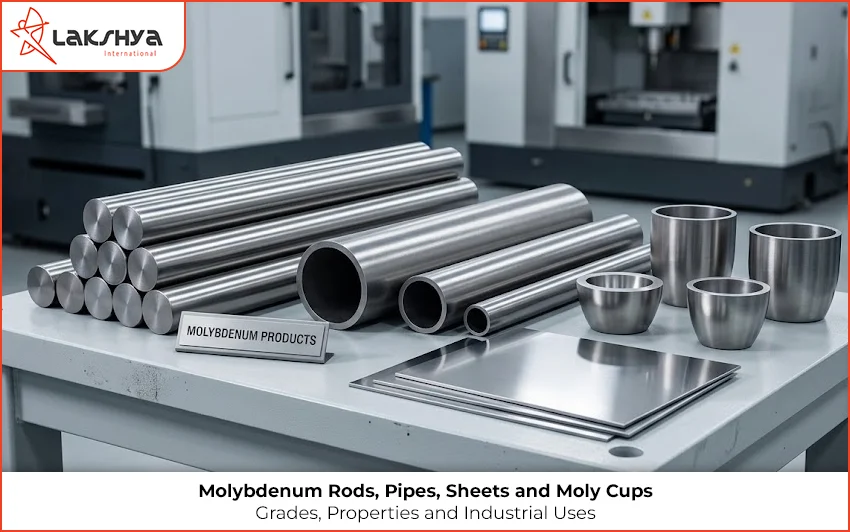
Molybdenum rods, pipes, sheets and moly cups all start as the same grey metal, one that melts at about 2,623 °C, yet each form is made a different way and does a different job. A moly cup is simply trade shorthand for a molybdenum cup or crucible. By definition, the primary molybdenum grades comprise pure molybdenum of 99.95% grade, TZM and Mo La. All of them are used within a vacuum environment, hydrogen or inert gas since molybdenum oxidation in air begins at around 400 °C.
This guide takes each form in turn: how it is made, the sizes and ASTM types that apply, the properties that matter and where it is used. It also covers the limits that decide every design choice, how to weigh a bar or a sheet, and what to put on an enquiry.
Lakshya International has been in the steel business since 1987 and works to ISO 9001:2015. This guide draws on ASTM B386, ASTM B387 and published supplier datasheets, and the forms we supply are on the product pages linked below.
Four Molybdenum Forms Compared: Rods, Pipes, Sheets, and Cups
The table below is the quickest way to see how the four forms differ. Sizes are typical and vary by supplier.
|
Form |
How it is made |
Sizes and finish |
Common grades |
Main uses |
|
Rods and bars |
Sintered billet, swaged, forged or drawn, then ground or chemically cleaned |
Round rod from 0.040 inch (about 1 mm). Wire from 0.020 inch (0.51 mm) under ASTM B387 |
Pure Mo, TZM |
Furnace parts, electrodes, vacuum and lighting parts, stock for machined cups and tubes |
|
Pipes and tubes |
Gun drilled from forged rod (smaller diameters), or extruded or sintered and drawn |
Ordered by outside diameter, wall and length. No pipe schedule system applies |
Pure Mo, TZM, Mo La |
Thermocouple sheaths, furnace liners, glass parts, capillary tubes |
|
Sheets and plates |
Sintered or arc cast slab rolled hot, then warm and cold, with anneals |
Sheet about 0.13 to 4.75 mm, plate thicker, foil below 0.13 mm. As rolled, cleaned or ground (ASTM B386) |
Pure Mo, TZM, Mo 30W |
Heat shields, boats, hot zone parts, sputtering targets, heat sinks |
|
Moly cups and crucibles |
Spun or deep drawn from plate, machined from rod or plate, or pressed and sintered |
Made to drawing. Wall thickness set by size and process |
Pure Mo, Mo La, TZM |
Sapphire crystal growth, rare earth melting, evaporation |
Note: pipe and tube are used loosely for molybdenum. There is no ASME B36.10 schedule system for it, so tubes are specified by drawing or customer specification. Sheet, plate and foil boundaries follow ASTM B386 as summarised by suppliers.
Molybdenum Grades: Pure Mo, TZM, Mo La and Other Alloys
Forms only make sense once you know the grades, because the grade sets how the metal behaves after heating.
|
Grade |
Composition |
What it adds |
Typical forms and uses |
|
Pure molybdenum |
About 99.95% Mo, low carbon and oxygen |
Highest purity, best conductivity, lowest cost |
Sheet, rod and machined parts; sputtering targets; heat shields |
|
TZM |
About 0.5% titanium, about 0.1% zirconium and 0.01 to 0.04% carbon |
Higher strength, creep resistance and recrystallisation temperature |
Furnace hardware, hot working tools, high load parts |
|
Mo La (ML, MLR, MLS) |
0.3% or 0.7% lanthanum oxide |
Stacked fibre structure stable to about 2,000 °C, better ductility after heating |
Crucibles, hot zone parts, lighting and furnace wire |
|
MHC |
About 1.2% hafnium and 0.05 to 0.12% carbon |
Very high strength |
Demanding high temperature structures |
|
Mo 30W |
27 to 33% tungsten |
Higher melting point and density |
Specialist high temperature parts |
|
Mo Cu composite |
Copper bonded to molybdenum |
Thermal conductivity with low expansion |
Heat sinks and electronic packaging |
ASTM B386 and B387 Types
Both standards use the same six type numbers, B386 for plate, sheet, strip and foil and B387 for bar, rod and wire.
|
Type |
Material |
|
360 |
Unalloyed vacuum arc cast molybdenum |
|
361 |
Unalloyed powder metallurgy molybdenum |
|
363 |
Vacuum arc cast molybdenum with 0.5% titanium and 0.1% zirconium (TZM) |
|
364 |
Powder metallurgy TZM |
|
365 |
Unalloyed vacuum arc cast molybdenum, low carbon |
|
366 |
Vacuum arc cast molybdenum with 30% tungsten |
Ask which type your certificate cites. Mo La is often sold under supplier designations such as ML rather than an ASTM type number, so ask which standard its certificate follows.
How Molybdenum Products Are Made: From Powder to Finished Form
Molybdenum is not cast and forged like steel. Most product starts as powder, which is why density, grain and impurity levels differ between suppliers and between forms.
Pressing and Sintering
Molybdenum powder is pressed into a compact by cold isostatic pressing, die pressing or hot pressing, then sintered in hydrogen or vacuum. Published sintering temperatures run from about 1,400 to 2,300 °C depending on the product, and tube billets are commonly sintered at about 1,800 to 2,100 °C. Vacuum arc cast material (types 360, 363, 365 and 366) skips the powder route and is melted in a vacuum arc furnace instead.
Working the Billet
The sintered billet is worked hot to refine the grain and give it strength. Rod is swaged, forged or drawn, tube is extruded or gun drilled, and sheet is rolled hot at roughly 1,100 to 1,400 °C. Later passes are warm and finally cold, with stress relief anneals between stages so the metal does not crack.
Finishing and Inspection
Finishing includes chemical cleaning to remove surface oxide, grinding or polishing to the required surface, and machining to drawing. Tube and cups are checked for size and wall, and material for electronic use is checked for purity, often at 99.95% or better. Ask for an EN 10204 certificate so the route and the chemistry are on record.
Key Properties of Molybdenum
|
Property |
Typical value |
What it means in use |
|
Melting point |
About 2,623 °C |
Sets the ceiling only in vacuum or inert gas |
|
Density |
About 10.2 g/cm3 |
About half the density of tungsten. Sintered parts run lower, roughly 9.8 to 10.0 |
|
Thermal conductivity |
About 138 W/m·K |
Moves heat well, which suits heat sinks and furnace parts |
|
Thermal expansion |
About 4.8 to 5.1 µm/m·K |
Less than half that of carbon steel, so parts hold their size when heated |
|
Electrical resistivity |
About 5.2 µΩ·cm near 0 °C |
Low, which suits electrodes and leads |
|
Vapour pressure |
Low |
Suits vacuum work |
Oxidation, Atmosphere and Brittleness: The Limits That Decide the Design
Every molybdenum choice starts here. The metal is strong at temperatures where steel has long since softened, but three limits shape how it can be used.
Oxidation in Air
Below about 400 °C, molybdenum is not oxidised to any real degree in air. From 400 °C it forms molybdenum oxide that begins to sublime, oxidation is strong above about 600 °C, and the oxide sublimes rapidly above about 700 °C. Water vapour makes it worse. That is why high temperature molybdenum runs in vacuum, hydrogen or inert gas such as argon, or is coated.
Corrosion Behaviour
Molybdenum resists many non oxidising mineral and organic acids and is not attacked by many molten glasses. It resists molten lead, gallium, lithium, sodium, potassium and bismuth, but molten aluminium, iron, cobalt, nickel, tin and zinc do attack it. It corrodes in oxidising acids and in alkalis that contain oxidising agents. Any claim of corrosion resistance should carry these limits.
Brittleness and Forming
Recrystallised molybdenum can be brittle at room temperature. One patent on crucible making puts the ductile to brittle transition of a part between 200 and 650 °C, depending on its shape and thickness. Forming is therefore done warm, and stress relieved sheet generally bends better than fully recrystallised sheet.
Recrystallisation
Heating above the recrystallisation temperature coarsens the grain and cuts ductility. TZM and Mo La exist to push that temperature up. One Mo La datasheet puts it at about 1,300 °C, and the fibre structure of the alloy also keeps it more ductile afterwards.
Molybdenum Rods and Bars: How They Are Made, Sizes and Uses
Rod and bar are pressed from powder into a billet, sintered at very high temperature in hydrogen or vacuum, then swaged, forged or drawn to size. Surfaces are supplied as worked, chemically cleaned or ground. ASTM B387 covers rod, bar and wire in the six types above, and wire down to 0.020 inch (0.51 mm).
Typical uses, each with a reason: heating elements and supports in furnaces, because they keep their shape at temperature; electrodes for glass melting, because molten glass barely attacks them; ion implantation and vacuum tube parts, because of low vapour pressure; X ray tube anode stems, because of heat handling; and rod stock for machining small cups and tubes. Our molybdenum rods and bars page lists the sizes and types we work with.
Condition matters as much as grade. As worked rod is stronger and harder than recrystallised rod, and it is a common starting point for machined parts. Rod that runs above its recrystallisation temperature will recrystallise in service, so consider TZM or Mo La rod if it must stay strong after heating.
Molybdenum Sheet and Plate: Thickness, Finish and Uses
Sheet starts as a sintered or arc cast slab. It is hot rolled at roughly 1,100 to 1,400 °C, then rolled warm and finally cold, with anneals between stages. ASTM B386 covers plate, sheet, strip and foil in the six types above, and material is supplied stress relieved or recrystallised, with as rolled, cleaned, machined or ground surfaces.
Uses include furnace heat shields and hot zone parts, boats for evaporation, sputtering targets that call for purity of 99.95% or better, heat sinks and lead frames, and the back contact layer in CIGS solar cells (a sputtered molybdenum film, not a sheet substrate). Copper bonded to molybdenum gives composite sheet for thermal management. See our molybdenum sheet page for the types and sizes we handle.
Two more points help when you choose sheet. Rolling gives the sheet a direction, so properties in the rolling direction differ from those across it, and deep drawn parts such as cups depend on how well the mill controls that. And thickness tolerance should be stated on the drawing, because it is set by agreement with the mill.
What Are Moly Cups? Molybdenum Crucibles and How They Are Made
A moly cup is a cylindrical container that holds a melt or process material at very high temperature. Most are made in one of three ways: spinning or deep drawing from rolled plate, machining from rod or plate, or pressing and sintering to near net shape. Sintered parts run at about 9.8 to 10.0 g/cm3, while forged or spun parts reach about 10.2.
Uses include sapphire crystal growth (heat exchanger, edge defined film fed and Kyropoulos methods), rare earth melting, vacuum evaporation, glass and quartz melting, and sintering fixtures. A large sapphire crucible described in one patent is about 43 cm across and 51 cm deep with a 1.0 to 2.5 mm wall, and weighs at least 23 kg.
Cups fail in two known ways. At very high temperature the grain coarsens and the wall can crack along grain boundaries. And where molybdenum touches graphite, carbon and molybdenum form a low melting liquid, which is why a tungsten plate is often placed between them. Mo La reduces the first problem. Cups are made to drawing, so if you are planning one, send the drawing, temperature and atmosphere through enquiry now.
Where Each Molybdenum Form Is Used: Industry Guide
|
Industry |
Typical parts |
Form |
Why molybdenum |
|
High temperature furnaces |
Heat shields, heating elements, supports |
Sheet, rod |
Holds strength and shape in vacuum or hydrogen |
|
Glass melting |
Electrodes, stirrers, liners |
Rod, tube, sheet |
Molten glass barely attacks it |
|
Crystal growth |
Crucibles and dies |
Cups, plate |
High melting point, stable size, clean melt |
|
Semiconductors and solar |
Sputtering targets, back contact, heat sinks |
Sheet, plate |
High purity, low expansion, good conductivity |
|
Lighting and electron tubes |
Support wires, stems, leads |
Rod, wire |
Low vapour pressure, matches glass seals |
|
X ray and medical equipment |
Tube anodes and stems |
Rod, sheet |
Heat handling and stiffness |
Applications as listed on supplier datasheets. Confirm the fit for your own duty.
Molybdenum Metal vs Molybdenum Bearing Steels and Alloys
Searches for molybdenum often turn up stainless steels, nickel alloys and chromium molybdenum steels. Those contain molybdenum as an alloying element, typically a few percent, and behave nothing like the metal.
|
Material |
Molybdenum (%) |
Typical use |
|
Molybdenum metal |
About 99.95 |
Vacuum and inert gas high temperature parts |
|
316 and 316Ti stainless steel |
2.0 to 3.0 |
Corrosion resistant process equipment |
|
Inconel 625 |
8.0 to 10.0 |
Aggressive corrosion and high temperature service |
|
Hastelloy C276 |
15.0 to 17.0 |
Severe chemical corrosion |
|
15CDV6 steel |
0.80 to 1.00 |
High strength structures |
For those materials, see our pages on 316 and 316Ti stainless steel, Inconel products,Hastelloy products and alloy steel products. For a worked chemistry example of a molybdenum bearing steel, read our 15CDV6 steel composition guide.
One point of confusion is worth clearing up. ASME SA387 is a chromium molybdenum steel plate specification, not a molybdenum metal standard. The metal is covered by ASTM B386 and B387.
Molybdenum vs Tungsten, Tantalum and Stainless Steel
|
Property |
Molybdenum |
Tungsten |
Tantalum |
Stainless steel |
|
Melting point (°C) |
2,623 |
3,422 |
3,017 |
About 1,400 to 1,530 |
|
Density (g/cm3) |
About 10.2 |
About 19.3 |
About 16.6 |
About 8.0 |
|
Typical role |
The most widely used and least costly refractory metal |
Highest melting point, very heavy |
Acid resistance and formability |
Air service and general corrosion resistance |
Typical reference values.
Molybdenum has about half the density of tungsten and is generally easier to machine and fabricate, which is why it is the default refractory metal when 2,623 °C is enough. Ourtantalum products page covers the alternative when acid resistance matters more than temperature.
How to Choose the Right Molybdenum Grade and Form
|
Requirement |
Best choice |
Why |
|
High purity for sputtering or electronics |
Pure Mo, 99.95% or better |
Lowest impurities and vacuum compatible |
|
Higher strength and creep resistance at temperature |
TZM |
Titanium and zirconium carbides strengthen the grain |
|
Stays ductile after heating above recrystallisation |
Mo La |
Stacked fibre structure limits embrittlement |
|
Thin walled hot zone container |
Mo La or TZM cup |
Creep resistance and grain stability |
|
Machined furnace parts |
Pure Mo rod or plate |
Generally easier to machine than tungsten |
|
Cost-sensitive general use |
Pure Mo |
Least costly refractory metal |
Four Questions to Ask First
- Which atmosphere will it run in: vacuum, hydrogen, inert gas or air?
- What is the peak temperature, and how often is it cycled?
- Will it be heated above the recrystallisation temperature and then handled or bent?
- Which form, size and tolerance does the drawing need?
Molybdenum Weight Formulas and a Worked Example
Use a density of 10.22 g/cm3 for forged, rolled and drawn stock. Sintered parts run lower, so the results below are upper estimates for them. Steel weight tools use steel density, so do not use them for molybdenum.
|
Form |
Formula (kg, dimensions in mm) |
Example |
Result |
|
Round rod |
0.000008027 x diameter squared x length |
50 mm diameter, 1,000 mm long |
20.07 kg |
|
Sheet |
10.22 x thickness, per square metre |
3 mm thick, 1 square metre |
30.66 kg |
|
Tube |
0.000008027 x (OD squared minus ID squared) x length |
30 mm OD, 20 mm ID, 1,000 mm long |
4.01 kg |
For steel and alloy weights, our steel weight calculators are the right tool. Recheck any molybdenum figure against the actual density on your certificate.
FAQs about 304 Stainless Steel Tubes
What is a moly cup?
A moly cup is trade shorthand for a molybdenum cup or crucible, a thin walled container that holds a melt or process material at very high temperature. Most are made by spinning or deep drawing plate, machining from rod or plate, or pressing and sintering powder.
What is the melting point of molybdenum?
About 2,623 °C. Published values run from 2,610 to 2,623 °C because of rounding and purity, so quote one figure and call it typical. In practice the usable limit is lower and is set by the atmosphere, not the melting point.
What is the difference between pure molybdenum, TZM and Mo La?
Pure molybdenum is 99.95% or better. TZM adds about 0.5% titanium and 0.1% zirconium with a little carbon for higher strength and creep resistance. Mo La adds 0.3 or 0.7% lanthanum oxide so the metal stays more ductile after heating.
Does molybdenum rust or oxidise?
It does not rust like steel, and it is stable at room temperature. In air it starts to oxidise at about 400 °C and the oxide sublimes above about 700 °C, so hot molybdenum needs vacuum, hydrogen or inert gas.
Can molybdenum be welded or machined?
It can be machined, ground and formed, but it is hard and recrystallised material can crack, so forming is done warm. Welds in recrystallised metal can be brittle, so joints are often mechanical. Ask a fabricator about your specific part.
Is molybdenum the same as molybdenum steel or SA387 plate?
No. Molybdenum metal is about 99.95% Mo. ASME SA387 is a chromium molybdenum steel plate specification with a few tenths of a percent up to about 1% molybdenum, depending on grade. It is a steel, not the metal.
What are molybdenum rods and sheets used for?
Rods go into furnace parts, glass electrodes, vacuum and lighting parts, and stock for machining. Sheet goes into heat shields, boats, sputtering targets, heat sinks and lead frames. Both suit vacuum, hydrogen or inert gas rather than air.
How much does a molybdenum rod or sheet weigh?
Use 10.22 g/cm3. A 50 mm diameter rod 1,000 mm long weighs about 20.07 kg, and a 1 square metre sheet weighs 10.22 kg for every millimetre of thickness. Sintered parts weigh a little less. The weight section above gives the formulas.
Choosing Between the Four Forms: The Short Rule
Pick the form for the part, the grade for the temperature history, and the atmosphere before anything else. Rods and sheets suit most furnace and electronic work, tube suits sheaths and liners, and moly cups suit melts that need a stable container. Check the standard, the type, and the certificate before you order.
Related reading: the molybdenum rods and bars and molybdenum sheet pages list the types and sizes we work with, and more technical guides are on our blog. If you are unsure which grade suits your duty, send the details to our team through the enquiry page.