
It is a rare thing for a grade of industrial metal to provide a good combination of strength, ductility, machinability and cost. SAE 1018 steel provides just that, and that’s one reason it is one of the most sought after mild steel grades in the world. This material provides a reliable framework for industries like automotive, construction, oil & gas and general engineering when they need dimensional accuracy, workability properties (welding), and mechanical properties that do not vary a lot.
SAE 1018 steel is defined by the Society of Automotive Engineers (SAE), and also falls into the category of low-carbon steel, which means it can be shaped, welded, and machined easily and still offer reasonable strength levels. It provides a reliable, versatile, fabricable solution that is available in many forms (bars & rods, sheets and plates) for engineers and procurement teams.
In this guide, we will cover the composition, physical properties, mechanical properties, equivalents in other countries, standards, heat treatment options, applications, limitations, and a comparison of this grade of steel to similar grades. We will also explain why Lakshya Steel is a trusted source for this material world-wide.
What is SAE 1018 Steel?
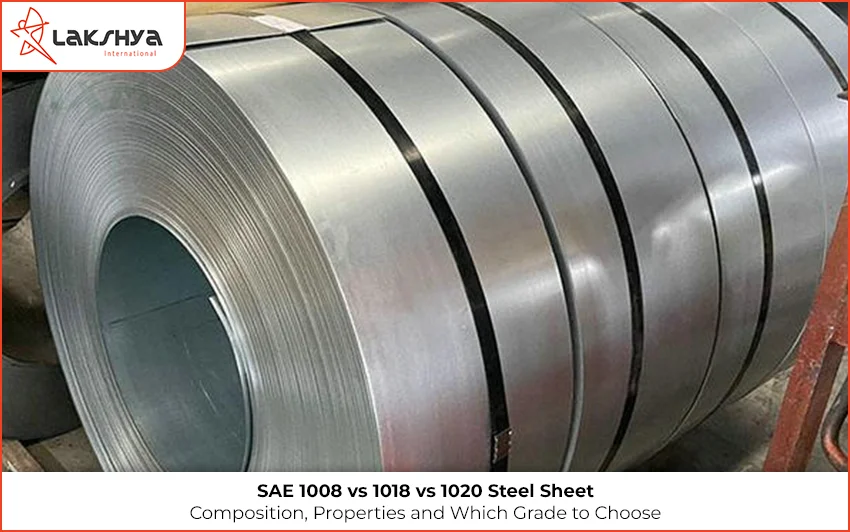
Low-carbon, mild steel with a carbon concentration of 0.15% to 0.20% is called SAE 1018. It is in the UNS G10180 group because of the amount of carbon in it. It can be made in either hot-rolled or cold-drawn form. Cold-drawn SAE 1018 is better for precision parts because it is stronger, has a better surface polish, and is more accurate in terms of size than hot-rolled SAE 1018, which is cheap for general use.
Its fair collection of qualities makes it a choice among businesses that need to create a lot of high-precision parts, like shafts, pins, bolts, gears, and structural support. SAE 1018 is easier to weld than steels with greater carbon percentages, which is important in many businesses that make things.
SAE 1018 Chemical Composition
The steel’s chemical composition is the foundation of its performance. In low-carbon steels like SAE 1018, the precise balance of elements determines the machinability, weldability, hardness, and overall durability. Manganese plays a major role in improving tensile strength without sacrificing ductility, while phosphorus and sulfur, in controlled amounts, enhance machinability.
Complete Composition Table
|
Element |
Percentage (%) Range |
Function in Alloy |
|
Carbon (C) |
0.15 – 0.20 |
Provides strength and hardness; low content improves ductility. |
|
Manganese (Mn) |
0.60 – 0.90 |
Boosts tensile strength and wear resistance. |
|
Phosphorus (P) |
≤ 0.040 |
Improves machinability but excessive amounts may cause brittleness. |
|
Sulfur (S) |
≤ 0.050 |
Aids machinability; high levels may reduce toughness. |
|
Iron (Fe) |
Balance |
Base matrix for ductility, toughness, and magnetism. |
Key takeaway: The low carbon content allows for excellent weldability and formability, while manganese ensures that strength is not compromised.
SAE 1018 Material Properties
Beyond its chemistry, SAE 1018’s physical properties define how it performs under environmental and operational conditions. For instance, its density is important in structural calculations, while thermal expansion rates are critical for precision assemblies exposed to heat. These properties also determine how the steel behaves during heat treatment, machining, and welding.
|
Property |
Value |
Significance |
|
Density |
7.87 g/cm³ |
Helps determine weight for design and load calculations. |
|
Melting Point |
1,425–1,537 °C |
Allows high-temperature forming without degradation. |
|
Modulus of Elasticity |
~205 GPa |
Indicates stiffness; critical for structural integrity. |
|
Electrical Conductivity |
~15% IACS |
Suitable for applications requiring moderate electrical conduction. |
|
Thermal Conductivity |
~51.9 W/m·K |
Efficiently dissipates heat in moving parts. |
|
Coefficient of Thermal Expansion (20–100°C) |
~11.7 µm/m°C |
Predictable thermal expansion ensures dimensional stability. |
SAE 1018 Mechanical Properties
The mechanical performance of SAE 1018 determines whether it is fit for structural loads, rotating machinery, or wear-prone parts. Its yield strength and tensile strength make it suitable for moderate load applications, while its ductility ensures it can be shaped and formed without cracking.
|
Condition |
Tensile Strength (MPa) |
Yield Strength (MPa) |
Elongation (%) |
Modulus of Elasticity (GPa) |
|
Hot-Rolled |
~440 |
~370 |
15–20 |
205 |
|
Cold-Drawn |
~485 |
~415 |
10–15 |
205 |
Hardness & Impact Resistance
|
Scale |
Value |
Notes |
|
Brinell Hardness (BHN) |
126–163 |
Good for moderate wear resistance. |
|
Rockwell Hardness (HRB) |
71–79 |
Balances machinability with strength. |
Why this matters: Cold drawing improves strength, making SAE 1018 suitable for tight-tolerance parts in automotive and engineering equipment.
SAE 1018 Equivalent Grades
In global trade, knowing the equivalent grades allows for sourcing flexibility without compromising on quality. However, even small variations in composition can alter machinability or heat treatment response, so substitutions must be evaluated carefully.
|
Standard |
Equivalent Grade |
Notes |
|
ASTM |
A29, A108 |
Widely used in North America. |
|
DIN |
Ck15 |
German equivalent; check Mn levels. |
|
EN |
C15E |
European low-carbon equivalent. |
|
JIS |
S15C |
Japanese equivalent for automotive applications. |
|
IS |
C15 |
Indian standard; often used in structural work. |
SAE 1018 Steel Standards & Specifications
Industry standards ensure that SAE 1018 steel meets uniform quality benchmarks regardless of the supplier. These certifications are especially important in oil & gas, automotive, and infrastructure projects where safety is non-negotiable.
- SAE J403: Defines chemical composition for carbon steels.
- ASTM A29/A108: Specifies requirements for hot-rolled and cold-finished bars.
- ISO 683-1: Covers non-alloy steels intended for heat treatment.
Pro Tip: Always request mill test certificates (MTCs) to confirm compliance with these standards.
Heat Treatment & Workability
SAE 1018 responds well to a variety of heat treatment processes, allowing manufacturers to tailor properties to specific needs. Before listing them, it’s important to note that heat treatment can affect hardness, toughness, and dimensional stability.
Heat Treatment Processes
- Normalizing: Improves grain structure for consistent machining.
- Annealing: Reduces hardness for easier forming.
- Carburizing: Creates a hardened surface while keeping the core ductile.
- Stress Relieving: Prevents distortion after machining.
Machinability, Weldability & Forming
Its machinability rating (~78% of B1112) makes it suitable for high-speed CNC machining. It welds cleanly using MIG, TIG, or arc welding without preheating and can be cold-formed into complex geometries without cracking.
Applications of SAE 1018 Steel
Before we study the list keep in mind the versatility across the industries for the cost-effective and consistently reliable performance associated with SAE 1018.
Industry Applications:
Automotive: SAE 1018 is known to be used for fasteners, shafts, gears, steering components, etc., where machining and dimensional tolerances are required. Knowing that SAE 1018 has a good strength-to-weight ratio and weldability means that it is useful for producing OEM parts at high volume and customization; parts for the automotive industry can be very diverse.
Construction: SAE 1018 can be found in anchor bolts, structural support systems, and reinforcing bars which specify stability and durability features in building systems. With stable structural performance, it has predictable performance levels when subjected to load, which supports overall safety and compliance with structural codes.
Oil & Gas: SAE 1018 is fairly common for use in brackets, clamps, and general-purpose fittings. Steel grades can be chosen based on reliability and machinability for producing parts that might ultimately be used in pipelines, rigs, or even support structures. Protective coatings will be necessary for SAE 1018 used in environments with high corrosion elements, but the toughness of this steel is a large advantage used in moderate service conditions.
Engineering: SAE 1018 is preferred for spindles, pins, and precision machine parts. Features like a consistent finish and tolerance levels are often requested after machining. Based on the end application, SAE 1018 is compatible for machining using CNC and heat treatment processes to produce a part that meets wear resistance and/or structural needs.
Limitations of SAE 1018 Steel
Low Corrosion Resistance: SAE 1018 lacks significant alloying elements like chromium or nickel, making it prone to rust in humid, marine, or chemically aggressive environments. Protective coatings, plating, or painting are often necessary for long-term durability.
Limited Hardness Potential: Even with heat treatment, SAE 1018 cannot achieve extreme hardness levels compared to medium- or high-carbon steels. This makes it less suitable for heavy-duty wear parts or tooling that require high abrasion resistance.
Not Ideal for High-Load/High-Temperature Applications: The relatively low tensile and yield strength limits its performance in applications involving extreme stresses or elevated operating temperatures. For such environments, alloy steels or higher-carbon grades are typically a better choice.
SAE 1018 vs Other Steel Grades
Comparing SAE 1018 with SAE 1020 and ASTM A36 reveals where it shines and where alternatives might be better.
|
Property |
SAE 1018 |
SAE 1020 |
ASTM A36 |
|
Carbon (%) |
0.15–0.20 |
0.17–0.23 |
0.25–0.29 |
|
Tensile Strength (MPa) |
440–485 |
410–480 |
400–550 |
|
Weldability |
Excellent |
Excellent |
Good |
|
Cost |
Moderate |
Moderate |
Low |
Why Choose Lakshya Steel for SAE 1018 Supply
When it comes to getting your SAE 1018 steel, there is significantly more than just price to assess for long-term value and any organization should thoroughly evaluate quality, consistency and technical support. These are all areas where Lakshya Steel excels and demonstrates value for long-term supply relationships. By combining ISO-certified manufacturing and inspection systems with a large list of inventory ready to ship in a number of forms, Lakshya Steel has its customers covered. In addition to cut-to-length and a variety of custom sizes just in time, reducing waste and increasing efficiencies. We have global supply capabilities that allow for urgent timelines to be delivered quickly. Moreover, we offer technical expertise to OEMs, fabricators, and engineering organizations to help them choose the best material for any application. The culmination of quality assurance, supply, and industry expertise make Lakshya Steel an easy sourcing experience for SAE 1018 steel in sourcing.
Conclusion
SAE 1018 steel remains a go-to material for engineers, fabricators and procurement teams because of its excellent mechanical properties, consistent machinability and weldability. Its versatility across sectors, from automotive and engineering to construction and oil & gas, makes it a reliable material in both high-volume production and small-quantity and precision applications.
If your business is looking for a dependable supplier, Lakshya Steel can help. We provide more than just an extraordinary SAE 1018 product. With our ISO-certified quality processes, vast warehouse inventory, custom sizing, and rapid global shipping, Lakshya Steel guarantees you will receive material that meets the engineering specifications as well as project timeline. Regardless if you require bulk orders or specialized engineering grades, our years of experience allow you to source SAE 1018 steel with assurance and efficacy.