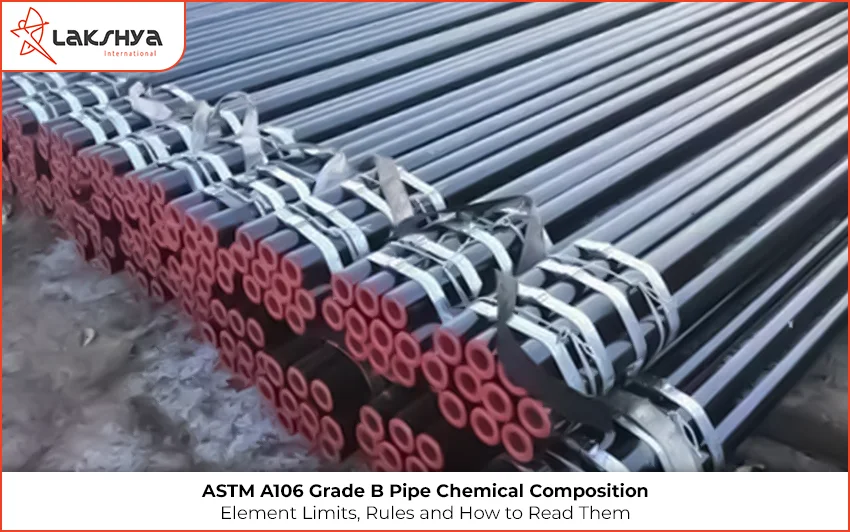
Checking the ASTM A106 Grade B pipe chemical composition on a mill certificate? Here is the short answer on A106 Grade B composition and SA106 Gr B chemical composition. Carbon tops out at 0.30%, manganese runs from 0.29 to 1.06%, phosphorus and sulfur are each capped at 0.035%, and silicon has to be at least 0.10%. This means the A106 Gr B carbon content, A106 Grade B manganese content, and A106 Grade B silicon content can be checked directly against the specified chemistry on the certificate. Chromium, copper and nickel stop at 0.40% each, molybdenum at 0.15% and vanadium at 0.08%, and those five together can never add up to more than 1%. ASTM A106 covers seamless carbon steel pipe for high temperature service, in Grades A, B and C, making it useful to understand the ASTM A106 Grade A vs B vs C composition before reviewing an A106 Grade B MTC.
Those numbers come from ASTM A106/A106M, and the same chemistry applies to SA106 Gr B chemical composition under the ASME code. Below we go through the full ASTM A106 Grade B pipe chemical composition table, the two footnotes that catch people out, and a simple way to check a certificate yourself. We also explain A106 Grade B carbon equivalent, identify A106 Grade B UNS K03006, and briefly compare A106 vs A53 vs API 5L Grade B chemical composition so you can understand what the chemistry on an A106 Grade B MTC actually means.
For related product specifications, see Lakshya Steel’s Carbon Steel Pipes and ASTM A106 Grade B Pipepages.
ASTM A106 Grade B Chemical Composition Table
The following table gives the standard heat analysis requirements for ASTM A106 Grade B pipe. The values are expressed as percentage by mass.
|
Element |
Symbol |
Requirement for Grade B |
|
Carbon |
C |
0.30% maximum |
|
Manganese |
Mn |
0.29% to 1.06% |
|
Phosphorus |
P |
0.035% maximum |
|
Sulfur |
S |
0.035% maximum |
|
Silicon |
Si |
0.10% minimum |
|
Chromium |
Cr |
0.40% maximum |
|
Copper |
Cu |
0.40% maximum |
|
Molybdenum |
Mo |
0.15% maximum |
|
Nickel |
Ni |
0.40% maximum |
|
Vanadium |
V |
0.08% maximum |
|
Cr + Cu + Mo + Ni + V |
Combined |
1.00% maximum |
What Each Element Does in A106 Grade B Pipe
The table tells you what is allowed. It does not tell you why, and knowing why makes certificates much easier to read. For the wider picture on how carbon shapes steel, our guide to carbon steel properties goes deeper.
Carbon. The A106 Gr B carbon content is capped at 0.30%. Carbon gives the pipe its strength, but every extra point makes welding harder and the heat affected zone less forgiving. That is why Grade B stops at 0.30% and the stronger Grade C is allowed to run to 0.35%.
Manganese. The A106 Grade B manganese content runs from 0.29 to 1.06%. Manganese lifts strength and toughness and ties up sulfur so it cannot cause cracking during hot working. There is a minimum as well as a maximum, which surprises people who only look for ceilings.
Phosphorus and sulfur. Both are impurities and both sit at 0.035% maximum. Lower is better, because low levels help toughness and reduce the risk of cracking in welds, which matters on pipe that will carry steam or hot oil.
Silicon. The A106 Grade B silicon content has a floor of 0.10% and no ceiling. Silicon is the deoxidiser, so the minimum tells you the steel was killed, which A106 requires. It is also one of the clearest chemical differences from A53, which sets no silicon minimum.
Chromium, copper, molybdenum, nickel and vanadium. These are not alloy additions here. They come in with scrap and process, and the standard caps each one and their total at 1%. The cap keeps the pipe a plain carbon manganese steel, so welding and heat treatment rules stay predictable.
The Manganese Adjustment Rule and the 1% Residual Cap, With Worked Examples
Most arguments about A106 Grade B composition come from the footnotes under the table, not the table itself. There are two, and both can be checked with a calculator.
Footnote one, carbon and manganese. For each 0.01% that carbon sits below its 0.30% maximum, manganese may go 0.06% above its 1.06% maximum. The ceiling depends on the document on your purchase order. Under ASTM A106, Grade B allows manganese up to 1.65% unless the purchaser specifies otherwise. Under ASME SA106 the ceiling is 1.35%.
Footnote two, the residual elements. Chromium, copper, molybdenum, nickel and vanadium must not add up to more than 1.00%, even when each one passes its own limit.
|
Carbon (%) |
Below 0.30 by |
Extra Mn allowed |
Mn limit, ASTM A106 (%) |
Mn limit, ASME SA106 (%) |
|
0.30 |
0.00 |
0.00 |
1.06 |
1.06 |
|
0.28 |
0.02 |
0.12 |
1.18 |
1.18 |
|
0.26 |
0.04 |
0.24 |
1.30 |
1.30 |
|
0.24 |
0.06 |
0.36 |
1.42 |
1.35 (capped) |
|
0.22 |
0.08 |
0.48 |
1.54 |
1.35 (capped) |
|
0.20 |
0.10 |
0.60 |
1.65 (capped) |
1.35 (capped) |
Manganese limit = 1.06 + 6 x (0.30 minus carbon), then capped at the ceiling of the document you order to.
Worked examples
- A pass. The certificate shows carbon 0.26 and manganese 1.25. Carbon is 0.04 below the maximum, so manganese may reach 1.30. The heat passes under both documents.
- It depends on the document. Carbon 0.24 and manganese 1.40. The allowance works out at 1.42, so the heat passes under ASTM A106. Under ASME SA106 the ceiling is 1.35, so the same heat fails.
- A fail. Carbon 0.28 and manganese 1.20. Carbon is only 0.02 below the maximum, so manganese is limited to 1.18. A reading of 1.20 is over the limit.
- The residual cap. Chromium 0.35, copper 0.35, molybdenum 0.10, nickel 0.35 and vanadium 0.05. Each one is inside its own limit, but together they make 1.20, which fails the 1.00 cap. A healthy heat looks more like chromium 0.10, copper 0.20, molybdenum 0.05, nickel 0.15 and vanadium 0.02, which totals 0.52.
Check the purchase order wording first. If it says ASME SA106, use 1.35% as the ceiling. The rule only matters when a certificate shows manganese above 1.06%.
ASTM A106 Grade A vs B vs C Composition and Strength
The three grades differ mainly in carbon and, at the low end, manganese. That carbon difference is also what drives the strength difference.
|
Property |
Grade A |
Grade B |
Grade C |
|
Carbon, max (%) |
0.25 |
0.30 |
0.35 |
|
Manganese (%) |
0.27 to 0.93 |
0.29 to 1.06 |
0.29 to 1.06 |
|
Phosphorus, max (%) |
0.035 |
0.035 |
0.035 |
|
Sulfur, max (%) |
0.035 |
0.035 |
0.035 |
|
Silicon, min (%) |
0.10 |
0.10 |
0.10 |
|
Chromium, copper, nickel, max each (%) |
0.40 |
0.40 |
0.40 |
|
Molybdenum, max (%) |
0.15 |
0.15 |
0.15 |
|
Vanadium, max (%) |
0.08 |
0.08 |
0.08 |
|
Five element total, max (%) |
1.00 |
1.00 |
1.00 |
|
Mn ceiling, ASTM A106 (%) |
1.35 |
1.65 |
1.65 |
|
Mn ceiling, ASME SA106 (%) |
1.35 |
1.35 |
1.35 |
|
Tensile strength, min, MPa (psi) |
330 (48,000) |
415 (60,000) |
485 (70,000) |
|
Yield strength, min, MPa (psi) |
205 (30,000) |
240 (35,000) |
275 (40,000) |
If you need the lower carbon option, see our ASTM A106 Grade A pipes. For the highest strength, our ASTM A106 Grade C pipes carry more carbon and need closer welding control. Grade B sits between them.
A106 vs A53 vs API 5L Grade B Chemical Composition
Suppliers often call these three pipes equivalent. Their strength minimums are very close. Their chemistry is not the same, and the table below shows where they part ways.
|
Element or feature |
A106 Grade B |
A53 Grade B (Type S) |
API 5L Grade B (PSL1, seamless) |
|
Carbon, max (%) |
0.30 |
0.30 |
0.28 |
|
Manganese (%) |
0.29 to 1.06 |
1.20 max |
1.20 max |
|
Phosphorus, max (%) |
0.035 |
0.05 |
0.030 |
|
Sulfur, max (%) |
0.035 |
0.045 |
0.030 |
|
Silicon (%) |
0.10 min |
No minimum |
Not specified |
|
Chromium, max (%) |
0.40 |
0.40 |
0.50 |
|
Copper, max (%) |
0.40 |
0.40 |
0.50 |
|
Nickel, max (%) |
0.40 |
0.40 |
0.50 |
|
Molybdenum, max (%) |
0.15 |
0.15 |
0.15 |
|
Vanadium |
0.08 max |
0.08 max |
Limited with Nb and Ti, see standard |
|
Combined residuals |
Five elements, 1.00 max |
Five elements, 1.00 max |
See standard |
|
Pipe making |
Seamless only |
Seamless (Type S) or ERW (Type E) |
Seamless or welded |
|
Minimum yield and tensile |
240 and 415 MPa |
240 and 415 MPa |
241 and 414 MPa |
A106 Grade B Carbon Equivalent: Formula and Worked Calculation
Carbon equivalent (CE) turns a heat analysis into one number that shows how hard the steel is to weld. The standard gives the IIW formula:
CE = C + Mn/6 + (Cr + Mo + V)/5 + (Ni + Cu)/15
|
Step |
Example A |
Example B |
|
Carbon (C) |
0.20 |
0.22 |
|
Manganese (Mn) |
0.85 |
1.20 |
|
Chromium, molybdenum, vanadium |
0.05, 0.01, 0.00 |
0.10, 0.02, 0.01 |
|
Nickel, copper |
0.03, 0.05 |
0.10, 0.15 |
|
Mn / 6 |
0.142 |
0.200 |
|
(Cr + Mo + V) / 5 |
0.012 |
0.026 |
|
(Ni + Cu) / 15 |
0.005 |
0.017 |
|
Carbon equivalent |
0.36 |
0.46 |
Illustrative values, not real heats. Example B has lower carbon than A, but the higher manganese (allowed by the footnote) still lifts the carbon equivalent.
A106 does not set a carbon equivalent limit on its own. A supplementary requirement gives the formula and lets the purchaser call up a limit, so the limit is an ordering choice. Figures such as 0.43 that appear on supplier pages usually come from a project specification or from API 5L PSL2, not from A106.
A106 Grade B is grouped as P Number 1 Group 1 in ASME Section IX, which is why welding procedures for it are so common. Preheat and heat treatment decisions still belong to your welding engineer and your project code.
How to Read the Chemical Section of an A106 Grade B Mill Test Certificate (MTC)
The chemistry on an A106 Grade B MTC is a heat analysis. The manufacturer analyses each heat of steel and reports the elements from the standard’s table. The pipe marking has to carry the heat number, so you can tie a length of pipe back to its certificate.
Product analysis is a separate check on the finished pipe. At the purchaser’s request the manufacturer analyses two pipes from each lot, and the results must still meet the table. If you want every length tested, a supplementary requirement asks for product analysis on each length, and any length that fails is rejected. When supplementary requirements apply, the pipe marking carries an S.
A106 calls for killed steel, made by the open hearth, basic oxygen or electric furnace route, with optional degassing or refining. If a remelting process such as ESR or VAR is used, the heat analysis comes from a remelted ingot.
|
Certificate field |
Example entry |
What to check |
|
Standard and grade |
ASTM A106/A106M Grade B, seamless |
Matches the purchase order, edition noted |
|
Heat number |
H12345 (example) |
Same number stencilled on every length |
|
Carbon (%) |
0.21 |
At or below 0.30 |
|
Manganese (%) |
0.88 |
0.29 to 1.06, or apply the footnote if above |
|
Phosphorus (%) |
0.014 |
At or below 0.035 |
|
Sulfur (%) |
0.006 |
At or below 0.035 |
|
Silicon (%) |
0.24 |
At least 0.10 |
|
Cr, Cu, Mo, Ni, V (%) |
0.06, 0.09, 0.02, 0.05, 0.003 |
Each inside its limit, and the total (0.223 here) not above 1.00 |
|
Carbon equivalent |
0.38 |
Only if the order sets a limit |
|
Certificate type |
EN 10204 3.1 |
3.2 if a third party witnessed the tests |
Mill test certificate for ASTM A106 Grade B seamless pipe with the chemical analysis columns for carbon, manganese, phosphorus, sulfur and silicon highlighted
A six step check
- Match the heat number on the certificate to the stencil on the pipe.
- Confirm the specification, grade and edition: ASTM A106/A106M or ASME SA106, Grade B, seamless.
- Compare every element with the composition table and confirm silicon is at least 0.10.
- If manganese is above 1.06, work out the allowed limit from carbon and check the ceiling for your document.
- Add chromium, copper, molybdenum, nickel and vanadium. The total must not exceed 1.00.
- Calculate the carbon equivalent if the order sets a limit, and confirm the certificate type is the one you ordered.
Equivalent Grades for A106 Grade B
Export buyers often search by European, German or Japanese designation. These are the nearest matches, not identical materials.
|
Standard |
Grade |
Note |
|
UNS |
K03006 |
The number assigned to A106 Grade B |
|
ASME |
SA106 Grade B |
Same chemistry, manganese ceiling of 1.35% |
|
EN 10216 Part 2 |
P265GH |
Nearest European grade, some lists show P235GH |
|
DIN 17175 |
St 45.8 (1.0405) |
Older German standard |
|
JIS G3456 |
STPT410 |
Nearest Japanese grade |
|
KS D3570 |
SPHT42 |
Nearest Korean grade |
FAQs about 304 Stainless Steel Tubes
What is the chemical composition of ASTM A106 Grade B?
Carbon 0.30% max, manganese 0.29 to 1.06%, phosphorus 0.035% max, sulfur 0.035% max, silicon 0.10% min, chromium 0.40% max, copper 0.40% max, molybdenum 0.15% max, nickel 0.40% max and vanadium 0.08% max. Chromium, copper, molybdenum, nickel and vanadium together must not exceed 1.00%.
What is the maximum carbon content in A106 Grade B?
0.30% on heat analysis. Carbon also drives the manganese rule: for each 0.01% below 0.30%, manganese may exceed 1.06% by 0.06%, up to the ceiling of the standard you order to. Lower carbon also helps weldability.
What is the manganese range for A106 Grade B, and can it exceed 1.06%?
The range is 0.29 to 1.06%. It can exceed 1.06% only when carbon is below 0.30%. The ceiling is 1.65% under ASTM A106 unless the purchaser says otherwise, and 1.35% under ASME SA106.
Does A106 Grade B require silicon?
Yes, at least 0.10%. Silicon is the deoxidiser, so the minimum is how the standard makes sure the steel is killed. The table sets no maximum. Some supplier pages show silicon up to 0.35%, which reflects normal mill practice rather than a limit in the standard.
What is the difference between A106 Grade A, B and C composition?
The carbon maximum rises from 0.25% for Grade A to 0.30% for B and 0.35% for C. Grade A allows 0.27 to 0.93% manganese, while B and C allow 0.29 to 1.06%. Other limits are identical. The extra carbon lifts minimum tensile strength from 330 to 415 and 485 MPa.
Is A106 Grade B the same as A53 Grade B?
Not in chemistry. A106 is seamless only, needs at least 0.10% silicon and holds phosphorus and sulfur to 0.035% each. A53 Grade B allows 0.05% phosphorus and 0.045% sulfur, sets no silicon minimum and also covers welded pipe. Yield and tensile minimums match.
How do I calculate the carbon equivalent of A106 Grade B?
Use the IIW formula, CE = C + Mn/6 + (Cr + Mo + V)/5 + (Ni + Cu)/15, with values from the heat analysis. A106 sets no limit unless the purchaser specifies one, so check the order. The worked example above shows each step.
What is the UNS number and equivalent of A106 Grade B?
The UNS number is K03006. The nearest European grade is EN 10216 Part 2 P265GH, the nearest older DIN grade is St 45.8 and the nearest JIS grade is STPT410. These are nearest equivalents, so confirm them against your project specification.
Checking A106 Grade B Chemistry: The Three Checks That Matter
For ASTM A106 Grade B pipe chemical composition, remember three checks: every element against the table, manganese against the footnote and the ceiling for your document, and the five residual elements against the 1.00 cap. Confirm silicon is at least 0.10 and ask for a carbon equivalent limit if the pipe will be welded. Do that with every A106 Grade B MTC and most problems show up before the pipe reaches site.
Need pipe to these limits? Browse our ASTM A106 Grade B pipes,Grade A pipes and Grade C pipes, see the full carbon steel products range, or send your requirements through Enquire Now. More technical guides are on our blog.